
“Can you help me? I think I’ve been scammed.” When Katja sends me a message on Facebook Messenger, she is already the third person that day. The scam season is open again. In housing groups on this social media platform, students are increasingly falling prey to scammers. The problem has been going on for years.
By: Marc van der Woude
Katja is not the first to sound the alarm. Recently, dozens of Wageningen University & Research students again became the victims of rental fraud. It happens throughout the year, but peaks around the General Introduction Days for students who start their studies or an exchange in August or February. Among them are also many international students who have not yet found a room. As time runs out, desperation increases, and with it the vulnerability to being scammed.
Katja is from the Czech Republic and is here for a four-month exchange as part of the Erasmus program. In the Facebook group Wageningen Student Housing (not related to our website), she posts an appeal. “I’m looking for a room for up to €450. If you know or have something, let me know!” she writes. Soon she is approached by one Dan E. “Are you still looking for an apartment in Wageningen?” he asks her in a PM. When Katja answers in the affirmative, he writes: “What is your Whatsapp number? Then my landlord can send you the details.” Unsuspectingly, Katja hands over her number.
She then has only a few days left to find a room and is only too happy that Dan has something for her at the last minute. The same day she receives a rental agreement from one Roy A. who introduces himself as the landlord. It concerns a room on Irenestraat in Wageningen, which Roy apparently rents from an address in Paris. Katja fills in her date of birth, passport number and other personal information, and signs and returns the rental agreement.
Dan no longer responds to her apps. Meanwhile, the rain is pouring down. She realizes she has been scammed.
When she arrives at her room on Irenestraat in Wageningen, an unpleasant surprise awaits her. Students do live in the building above Stroop Bakery, but they know nothing about it. Dan, with whom she had an appointment to receive the keys, is nowhere to be seen. When she calls him, he doesn’t answer. When she apps, he doesn’t respond. She realizes she has been scammed. Meanwhile, the rain is pouring down. Fortunately, she is able to stay with an acquaintance who lets her sleep on the couch for a night, although she cannot stay there.
Have you checked his profile?
Together with Katja, I walk through her correspondence with the scammer. “Did you check his profile?” I ask. “Did you notice anything in that?” Dan’s profile looks lovely. A pink rose as his profile picture, in the banner a girl hugging a golden retriever. Katja also happens to have a golden retriever, it immediately appealed to her. Furthermore, pictures that should give the impression that Dan is a travel-loving type, but it’s a hodgepodge – a Dutch canal, a lighthouse, an Eastern European-looking apartment building, a painting. The pattern doesn’t make sense. When I put some of the pictures into Google Image Search, it immediately becomes clear that the pictures were simply plucked from the Internet. Dan’s friends are not visible.
Scrolling all the way down on Dan’s timeline to his very first post on Facebook, a personal photo suddenly pops up after all. Three African boys look into the camera. The caption: “Believe in yourself! Have faith in your abilities! Without a humble but reasonable confidence in your own powers you cannot be successful or happy.” Even scammers have their inspirational memes.
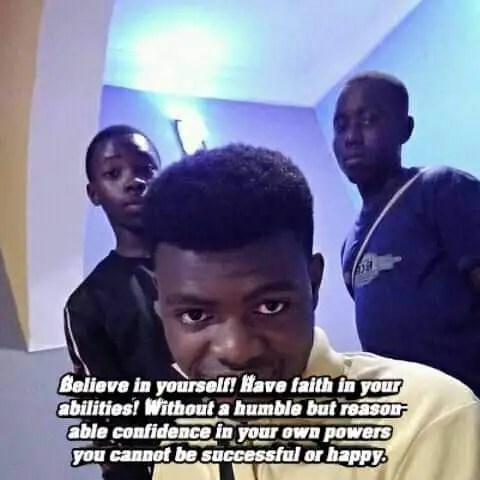
Here our Dan introduces himself as Raji, with a surname common in Nigeria. “Do you see that his original name is also in the url of the profile?” I ask Katja. “When he started scamming, he did change his profile name, but not the name he registered with on Facebook. A rookie mistake.” Raji turns out to be a student at Government College in Ibadan, Nigeria. That is a boarding (secondary) school for boys from Nigeria’s elite. The curriculum includes courses in “creative thinking, problem solving and effective writing, among other things.” Useful skills for those who want to moonlight as scammers.
It is quite possible that alleged landlord Roy A. is simply a classmate or relative of Raji O.’s. Katja received the rental agreement, drafted in English, at lightning speed. She transferred €450 to a bank number in Lithuania. “Do you think I can still get my money back? Shall I go to the police to report it?” she asks. “That’s hopeless,” I say. “Your bank can’t recover the money, and for the police it’s not a priority.”
Coming along, but not really
Inquiries at Stroop Bakery reveal that Katja is not the only one. Marina, a Dutch student from Ede, is offered an apartment at the same address on Irenestraat. This time by one Claas P. who sends her a set of photos. “I have your contact information from an ex-tenant who said you are looking for an apartment in Wageningen,” Claas apps from a Dutch mobile number. He says he is Dutch, but speaks only English. He offers Marina a fully furnished 35m2 studio apartment for a rent of €600 per month and a deposit of €550.
Claas turns out to be an extremely nimble type. “I also have a €250 room on Van het Hoffstraat,” he says.
When Marina points out that this is above her budget and she can pay a maximum of €250 a month, Claas proves to be an extremely nimble type. “I also have a €250 room on Van het Hoffstraat,” he says. “That one is 30 m2, also fully furnished and includes utilities. Available immediately, but you can also rent it from March or April.” And straight to the point: “How will you transfer the money?”
Marina gets suspicious and contacts Stroop Bakery. “We don’t have apartments,” says owner Sandra Stroop, “only student rooms, and when a room becomes available our tenants let us know.” When I forward her the photos used by the scammer, she confirms that these are not of her rooms. The photos look foreign. Often this can be seen in details, such as different radiators or electrical outlets. When I call the scammer’s mobile number from an anonymous account, it immediately switches to a Flemish-speaking voicemail service where no message can be left. The provider: Cheaty Mobile, freely translated: the telecom provider for scammers. How cynical.
When Claas apps a day later if Marina is still interested in the room on Van het Hoffstraat, I suggest her to play along a little more. She answers the questions he apps her about smoking, drinking and partying – meant to gain her trust – and provides made-up personal data for the lease. She receives it promptly, but the scammer is a little too eager. The dots where Marina can sign still has the name of the previous duped person. When she asks Claas for proof of his identity, she receives the scanned passport of a 26-year-old German. The real Claas P. turns out to be a student from Maastricht who was himself scammed in September 2021 when he forwarded his ID to rent an apartment. The scammer who duped him also used another victim’s passport again. “It’s a snowball effect,” Claas said.
A popular address from De Woningstichting
I also speak with Alice, an Italian student from Bologna. In the popular Facebook group Wageningen Student Plaza, she was scammed with an address on Veerstraat. “I should have been more careful before I sent the money,” she said. “But I was desperate that I hadn’t found a room yet and therefore wasn’t sharp enough.”
De Veerstraat is a social housing unit owned by De Woningstichting in Wageningen. In May 2020, Brazilian student Thiago was already scammed once with this address by one Annie S. She used photos of an American-style apartment that was also offered in housing groups in Maastricht, Galway, Portsmouth and Madrid. On social news platform Reddit, two French students already warned about it in spring 2017. So the address on Veerstraat has been in circulation for years. Housing consultant Jacqueline Annema of De Woningstichting reacts with surprise. “It’s the first time I hear this. No, we haven’t received any other reports.”
Police report against scammers Audrey B. and Mariana Q.
Luana, another Italian, mails me her report to the police in Wageningen. She has been scammed by Audrey B. and her companion Mariana Q. It concerns a room on the Dijkstraat in Wageningen with a rent of € 450 per month and a deposit of € 650. Mariana happened not to be in Wageningen because of her work and would arrange the rental remotely. A well-known scammer’s trick. The key would be handed over by a French student who would already be living at the address. Luana sent back the rental agreement unilaterally signed, and transferred two months’ rent + the deposit, a total of €1,550, to an IBAN in the UK. Upon arriving at the address, she realised it was a dodgy business. An occupant of the dorm confirmed upon inquiry that the address had been abused by scammers on several occasions, at least three times in the past four months.
Cédric from Spain works as a trainee at FrieslandCampina R&D. He was scammed by the same Audrey B. and Mariana Q., but the person who provided the lead this time was one Brad. He received photos and a video from a Facebook profile in Wageningen-Hoog about an apartment on the Nieuwe Kanaal on the west side of Wageningen, a new building complex of student housing provider Idealis. In the video, a glance out the window makes it immediately clear that the surroundings do not match the situation on site. For international students who do not know Wageningen, this is impossible to recognize, even if you use Google Streetview. The owner would mail the keys, which is not common. When I check the Facebook profile, Brad actually turns out to be named Joseph W. and lives in Ghana, like Nigeria a notorious scammers’ country.
The landlord who mails the lease – Roy A. – we know from Katja’s story. A search on Facebook shows that Audrey B. is also offering the same apartment in Reykjavik. Mariana Q. is also active in Utrecht and New York.
The students mentioned in this story came up with their stories themselves. They are the tip of the proverbial iceberg. Every year many hundreds of Wageningen students are scammed. Who are these scammers? How can you avoid falling prey to a housing scam? What are the police, housing group administrators, Facebook and the university doing about it? We’ll talk about that in a next story.
This publication was made possible in part by the Freelance Journalists Support Fund. It has been widely distributed in the housing groups on Facebook and will also appear in the local-regional press in mid-August 2023.
Emerge Media conducts investigative journalism independently and for media partners in the Food Valley. Got a tip? Send an email to info@emergemedia.nl and we’ll get back to you.
Don’t want to miss any new articles on student housing in Wageningen? Sign up and you’ll be the first one to receive them in your mailbox.
Together we can improve student housing in Wageningen. You can support our work with a small tip or donation.
 Wageningen Student Housing