

How can you avoid falling prey to a housing scam on Facebook? In my research into rental fraud, I have gained some insights that I am happy to share with you. Here are the best tips on how to detect a scammer, with concrete examples.
By: Marc van der Woude
Let me start on a positive note: it is quite possible to check almost conclusively whether an offer you get is correct or not. But you have to put some effort into it. The tips are arranged according to the steps in the hiring process.
Check the provider’s profile
- Check the provider’s profile picture. Is the face clearly visible? Are there more photos on the timeline in which the same person can be recognised? Tip: run the profile picture through a reverse image search engine such as Google Lens, Tin Eye or Yandex for a check. Then you can see pretty quickly whether the photo has been plucked from the web. You can also do this with the accommodation photos if necessary.
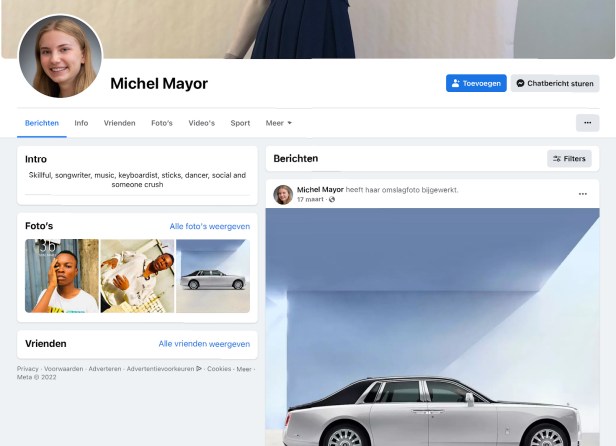
This scammer did pluck a profile picture of a student from the internet, but otherwise made little effort to hide who he is and what he is saving up for
- Check the friends list: does this person have an active and logical social network? Not everyone with a ‘skinny’ Facebook profile is a scammer, but scammers always have a skinny Facebook profile. They find it too much work to upload dozens of personal photos of someone else and spread them out over time to make it look sufficiently authentic.
- If there are pictures of African guys with expensive watches and cars on it, move on.
- Check how many groups someone is a member of. More than 100 is a red flag. Also check what kind of groups they are. Scammers are often in multiple housing groups in multiple countries and cities.
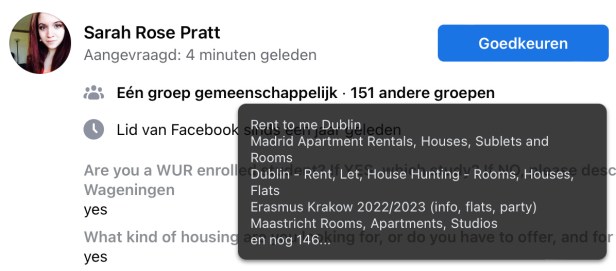
This scammer is active in more than 150 housing groups and is trying to invade a group in Wageningen here; another Wageningen group administrator already allowed her in
- Search the provider’s name both within Facebook and on Google and analyse the results. Many people who study or work at WUR (and are in a position to offer a room) are working on their careers and have profiles on LinkedIn or ResearchGate. If you don’t find any relevant ‘professional’ hits, that’s a red flag.
Check the ad
- If the offer is too good to be true, it is probably not true. A furnished 2-room flat for €500, for example, within walking distance of the university. That is not realistic in the Dutch housing market. To give you an indication of the real average market prices: for a non-self-contained student room in a student house €350, for a studio (with its own front door, kitchen and bathroom) €600, for a 2-room flat €800, for a 3-room flat €1000, and for more spacious houses between €1200 and €1800. These amounts are indicative and refer to the bare rent.
- If the provider has disabled comments under the message, it is to prevent observant group members from posting a warning. The scammer hopes you will send a PM (personal message on Messenger) so he can scam you behind the scenes.
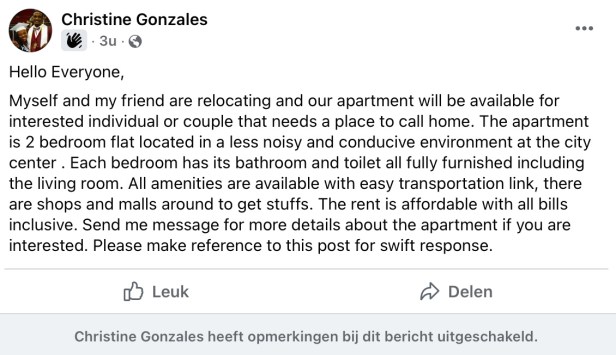
A too-good-to-be-true fake ad, with comments disabled
- Cut and paste a few sentences from the text of the ad into Facebook’s search window. Often scammers use the same texts in multiple groups. You can then see this immediately in the search results. Facebook Marketplace has a button that allows you to see all other offers from a seller as well.
- Photos often show remarkable details that determine whether you are dealing with a Dutch property or a foreign one. The radiators and sockets, for example, a gas cooker in the kitchen, packaging of food, the view from the window of the surroundings. Dutch houses are small in area, you can see this in the rooms, especially the bathroom and kitchen. If you are offered a spacious room or flat, then extra checks are wise.
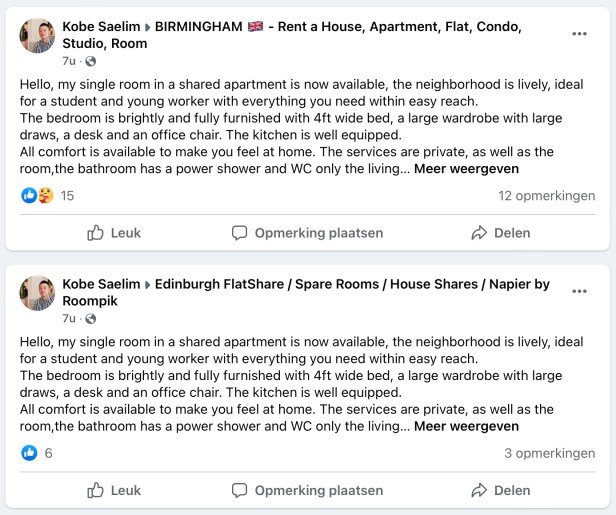
Nice and easy: same ad in housing groups in different cities
- Scammers usually use similar texts for ads. All the features of the property are listed in detail, there is no clear rental period (you can decide that yourself, which is unusual in the extremely crowded housing market in the Netherlands), it is fully furnished, the price includes gas, water, electricity and internet (in the Netherlands, this is always charged separately in regular rentals), and the location is always perfect (close to university, shops and city centre). This is not about the individual elements, but the combination of them.
- Another red flag: when several rooms in a property are offered at the same time and you can choose whether to rent just one room or the whole property. Such availability is rare in the Dutch market.
Ask for additional information
- If after the first contact you are immediately referred to someone else, usually a landlord who is abroad, with a number on Whatsapp, who is going to send you the contract, and cannot show you the property himself, count on it being a scam. This is such a transparent classic trick that you wonder why scammers still use it.
- Providers in the Netherlands will have a Dutch mobile number that starts with +31 (country code), followed by a 6. If it is a number from another country, then watch out.
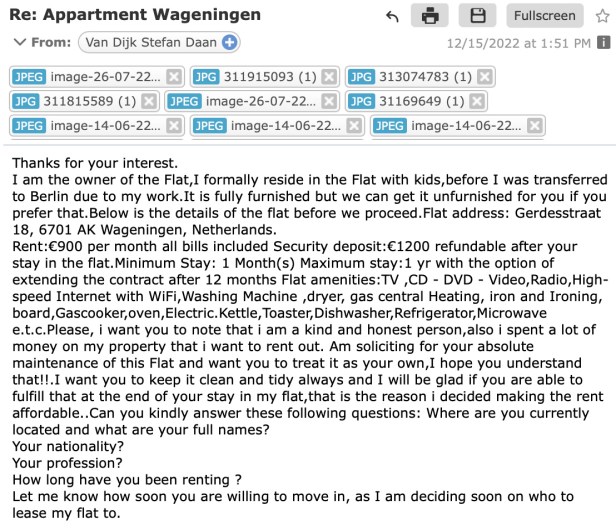
The typical first e-mail a scammer sends often includes the message that he is abroad
- Always request some information from the provider: his/her full name, the address of the accommodation, what his/her studies or work is, and what is the reason the provider is renting out his/her room.
- Which mail provider does the provider use? Yahoo is widely used by scammers, as well as providers like Protonmail where you can register addresses anonymously.
- The most important thing to check is whether the provider is actually the owner or main tenant of the accommodation in question. Accommodations in the tourism sector usually have their own website with a nl domain. Private owners can be checked at the Land Registry. A main tenant will be able to provide their current rental contract, so you can make enquiries based on that information.
- Does the provider himself live in the accommodation or in the immediate area? If not, be wary. It makes no sense for someone living in London or Maastricht, for example, to offer a flat in Wageningen and arrange that rental remotely.
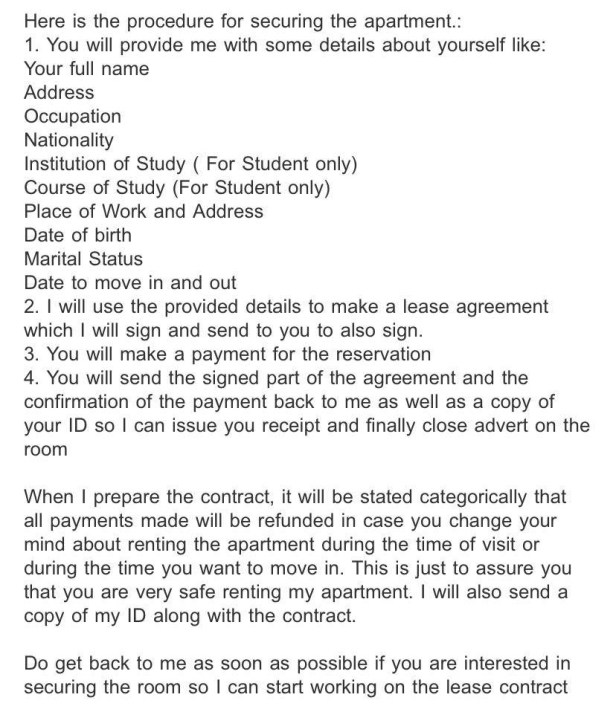
The scammer explains the procedure and tries to inspire confidence
- Usually, scammers use existing addresses of student houses and individuals. Check whether the address produces hits in Google and whether they match the provider’s name.
- Check the address in Streetview. Often, advertisements use only interior photos. You can feel free to ask a provider to also email a self-made recent photo of the facade. If he/she actually lives there, that won’t be a problem, which you can then check in Streetview. Also check the exif data of the photo with your right mouse button. When was it taken?
- Ask the provider if he/she can show you the room or house in a short video call, so you can check if it matches the photos. Also ask for some live images from outside, such as the street sign.
- Realise that if a scammer emails you his/her ID, ostensibly to inspire confidence, it is undoubtedly from someone else. Google that person and try to make contact by other means.
- Sometimes it is advised to check whether you can register with the municipality at the rental address. But that is not a criterion for whether something is a scam. It depends on the type of accommodation, the length of your stay, a landlord’s preference and so on. The rule of thumb: if you want to stay somewhere for more than four months, you should be able to register and get an official rental or sublease agreement. This is something you can discuss with the landlord or main tenant.
- As such, a landlord insisting on a quick decision is also not a scam indicator. In the Dutch market, demand is many times greater than supply. So a landlord will not give you a few weeks’ reflection time while dozens of others are jostling for the same room.
Check the rental agreement
- Ask for a rental agreement and check that it is professionally drafted. Scammers usually use very simple agreements of 3-4 pages. The headline is often in an uncommon font, from Comic Sans to Gothic. Content uses terms that are not common in Dutch rental agreements.
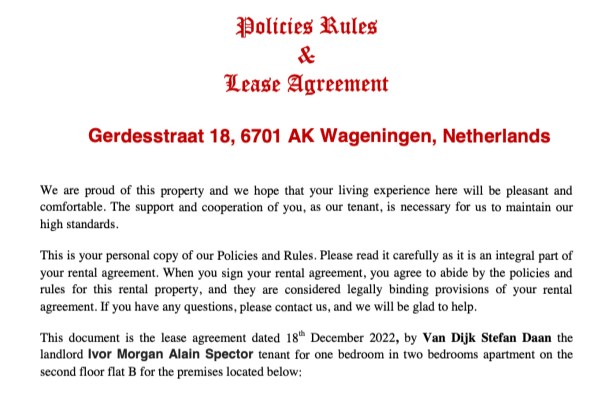
Screenshot of a rental contract as used by scammers
- In the case of subletting (a main tenant temporarily subletting to you, e.g. because of a stay abroad), an official subletting contract from the landlord must be used in the Netherlands. In Wageningen, half of all student accommodation is owned by Idealis. Ask for such a subtenancy contract and check with the landlord if the address belongs to them. This will also prevent you from subletting illegally.
- Under no circumstances mail or app a copy of your passport or ID. Scammers use these for identity theft – to scam other people or open a bank account in your name. Often, landlords do ask for your passport on arrival (i.e. at physical contact) or in a secure professional online environment (as part of the rental process), which is not a problem.
Keep a grip on the payment process
- There is quite often the advice to view a room first and only then pay. If you are already in Wageningen, this is of course possible, but if you are looking from abroad, this is not possible. Realise that paying in advance as such is not a red flag. Almost every provider will ask for a reasonable upfront payment of the first month’s rent and/or deposit.
- A classic scam trick: first sign the contract and transfer the money, after which you will be sent the house keys by post. No serious landlord will send you keys by post.
- If it is said that a lawyer is involved in the payment, a ‘housing committee’ has looked at the contract, or if there are any other kind of ‘complications’ in the interim that make you pay differently anyway, be wary. This is typical scammer behaviour.
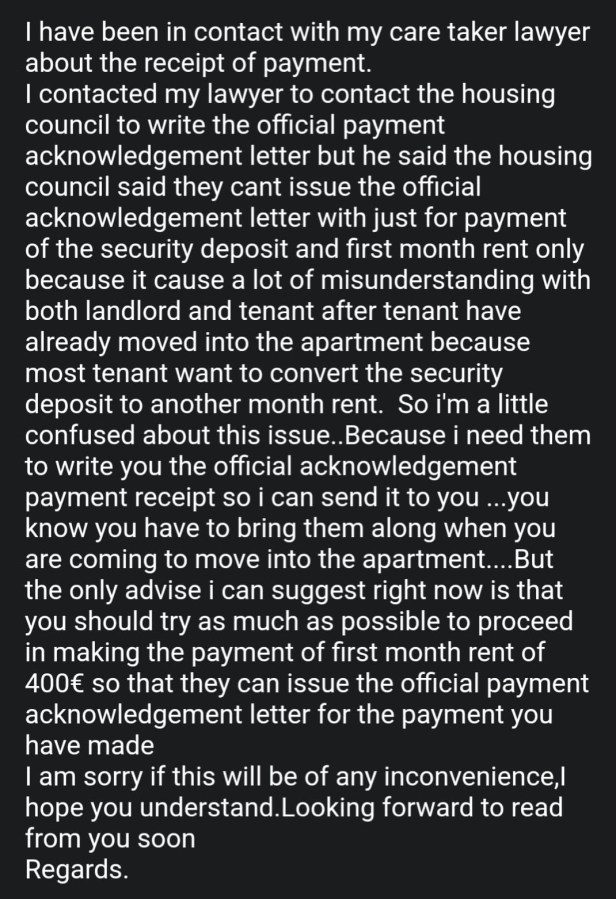
A scammer creating a ‘complication’ to prompt you to pay
- It is common in the Netherlands to pay by bank (or credit card if it is a tourist accommodation) to a Dutch bank account / IBAN. If you are asked to use a foreign account, be wary, it is probably a scam. Cash payments are also not common in the Netherlands.
- Payment via Western Union, MoneyGram, UPS or Airbnb is a no-go, then you can be sure it’s a scam. No serious landlord uses these services or runs a payment through Airbnb to tap 17% commission on it, but will always ask for a direct bank payment.
- Only pay once you have done the most relevant checks and received an agreement signed by both parties.
Finally
Does it make sense to make names of scammers and frequently used addresses public, as some other websites do? In my view, you gain little to nothing from this.
The frequently used addresses are really existing addresses of student houses or private individuals who themselves have nothing to do with rental fraud. They often don’t know their address is being used. Labelling it as a ‘fraud address’ unfairly puts them in a negative light. The same applies to names used by scammers. Often these are made-up names or the names of people they have scammed before.
On top of that, scammers change used names and addresses with regularity, so with such a list you are constantly behind the times.
This publication was made possible in part by the Freelance Journalists Support Fund. It has been widely distributed in the housing groups on Facebook and will also appear in the local-regional press in mid-August 2023.
Emerge Media conducts investigative journalism independently and for media partners in the Food Valley. Got a tip? Send an email to info@emergemedia.nl and we’ll get back to you.
Don’t want to miss any new articles on student housing in Wageningen? Sign up and you’ll be the first one to receive them in your mailbox.
Together we can improve student housing in Wageningen. You can support our work with a small tip or donation.
 Wageningen Student Housing