Every year, more international students come to Wageningen than there are rooms available. This causes much uncertainty and search stress among students. An analysis by the investigative journalism website Wageningen Student Housing shows that information from the university is inadequate.
By: Marc van der Woude
Recently, international students protested the room shortage on campus. They have since submitted a petition with 14 specific demands to the university’s Executive Board. Over 100 students provided input and 30 contributed directly. A conversation with Ingrid Hijman, head of the Student Service Center, also followed. “Unfortunately, our proposals were immediately rebuffed,” says student spokesperson Bia Cerqueira. “We didn’t really feel heard. The university gave conflicting information in the conversation. When I asked about this, I was told that arguing is pointless.”
Wageningen University spokesman Vincent Koperdraat said in a written response that housing is the responsibility of students themselves. The university consults annually with the municipality and student housing provider Idealis how many new students are expected and how many rooms are needed. This coordination does not mean that there is sufficient supply; the Dutch market simply has a structural shortage. Koperdraat acknowledges that the university does have primary responsibility for communication with students.
Where it goes wrong: expectation management
It is in this communication, including “expectation management,” that things seem to go wrong. International students report that on the official ROOM platform there is fierce competition around each room and they often miss the boat. “I never finished higher than 30th place,” says American student Kim Vanderwolk. “I try not to complain, people in the Netherlands also have a hard time with housing.”
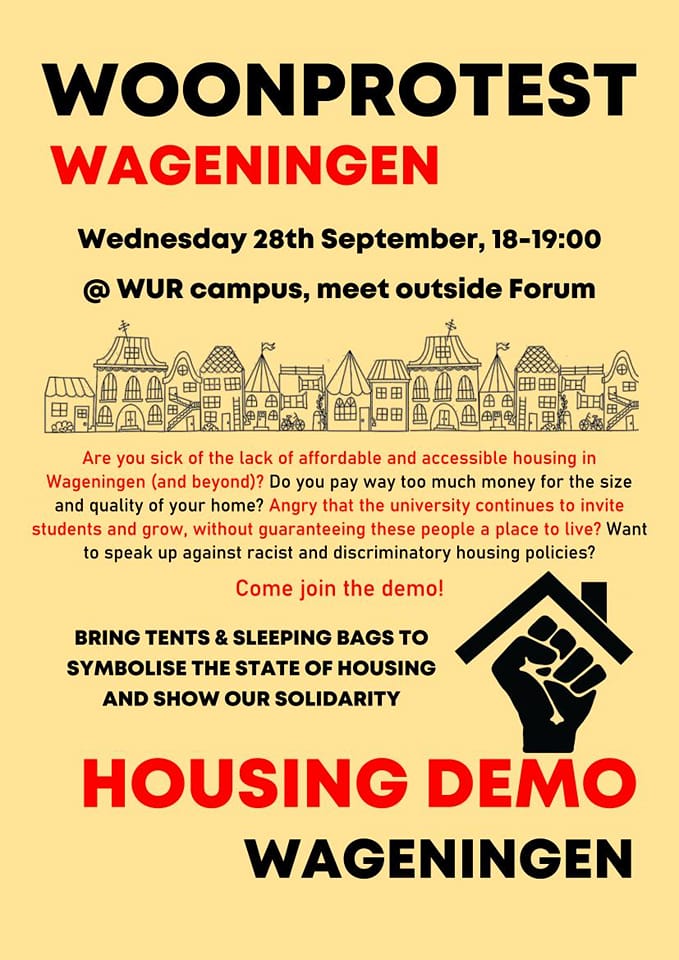
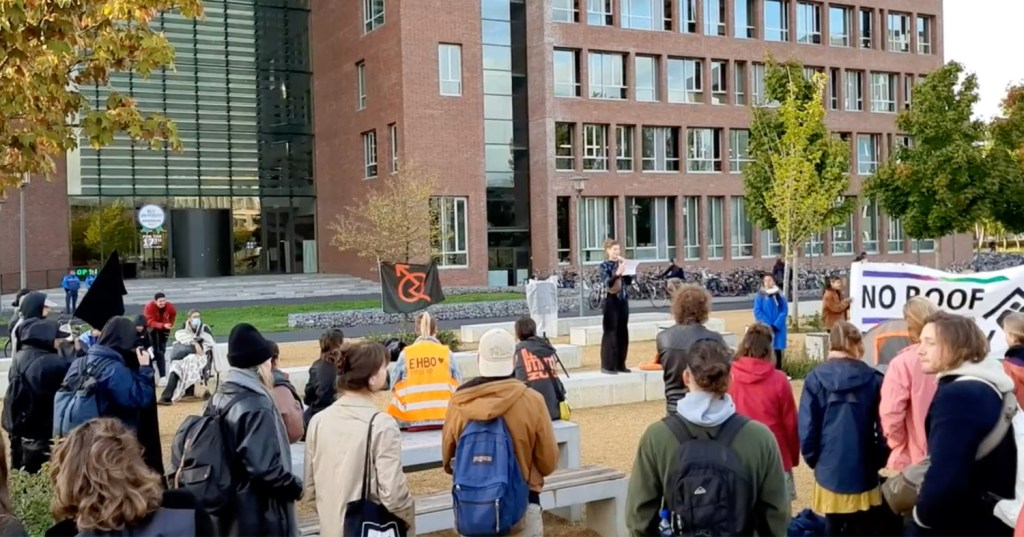

Images: left the recent housing protest on campus, right student spokesperson Bia Cerqueira
As a result, many international students end up in the tourism sector, which is expensive for them, in private airbnbs, in a tent at De Wielerbaan recreation park (also €750 per month) or on a couch with a fellow student. Or they hop from one temporary sublet option to another. This is evident from interviews Wageningen Student Housing conducted with students and providers. Students experience a lot of stress because of this and feel that the university has informed them too little and too late about the structural room shortage. They also indicate they have too little insight into the search options.
The university did not want to cooperate with our research. Therefore, students themselves forwarded all emails and letters to us, so that the actual communication could be analysed.
The university itself was unwilling to clarify what exactly is communicated to international students about housing and at what times. Therefore, I placed a call in the popular Facebook group Wageningen Student Plaza. Students forwarded the emails and letters they had received from the university. This showed that upon confirmation of their enrolment, students only received a link to the university’s general housing page, which listed some rental and mediation platforms without explanation. Because many students do not receive this confirmation until shortly before or in the summer vacation, the search period is very limited.
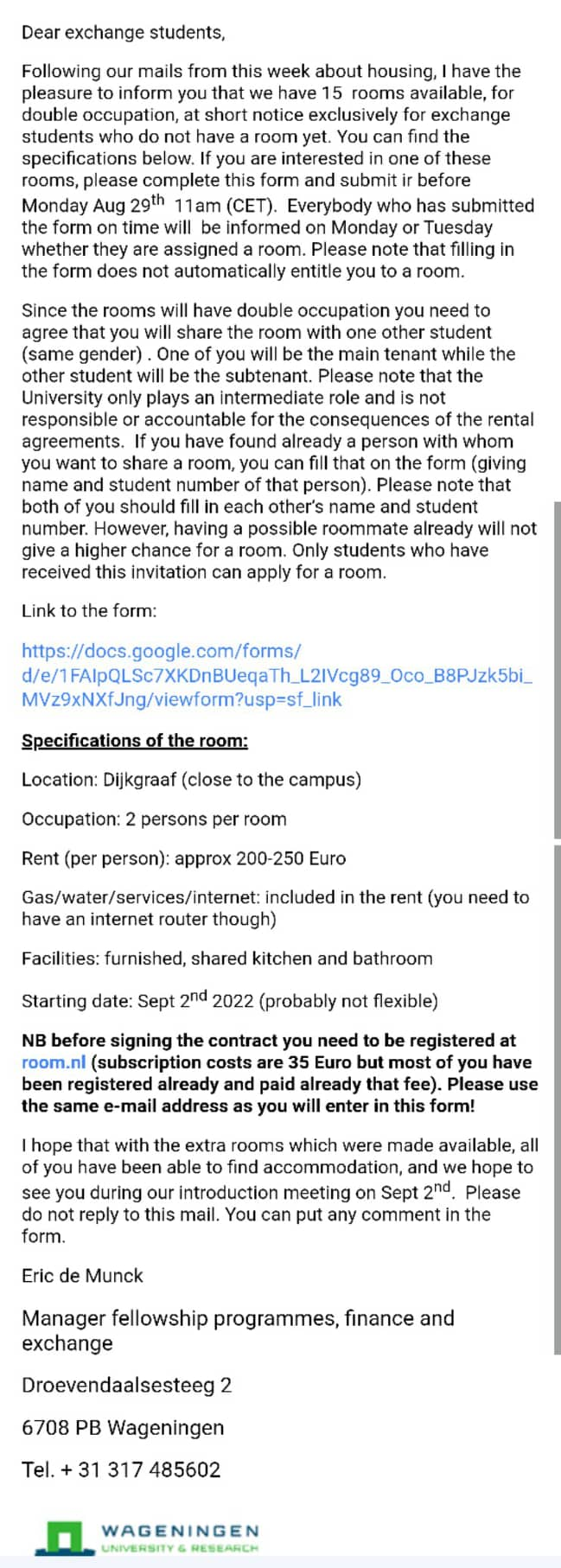
Only just before the introduction days, when it becomes clear that many of the 1,200 international starters have not yet found a room, the university emails, “We have heard that this is playing out throughout the Netherlands and also in other parts of Europe. The problem is apparently bigger than we thought.” In an e-mail in late August, a Student Service Center employee reported that 15 additional rooms have been hastily vacated, that two students can share. “I hope this is enough and with this you have all found housing,” he said.
There are well and ill-informed students
Inquiring with Linda Cents, manager of Housing and Real Estate at Idealis, reveals that there are two groups of students: well-informed and ill-informed.
If you haven’t found a room before arriving in Wageningen and decide to take up temporary residence in a hotel, you immediately lose your distance priority, as you will be within the 130km radius.
The first group involves full-time students who live – as the crow flies – more than 130 kilometers away from campus. They receive a “distance priority” that gives them priority over 850 reserved rooms in the ROOM system. “Distance priority takes precedence over enrolment,” says Cents, “although the reserved rooms are open to all students.” However, the priority is only valid for two months a year, from July 15 to September 15, precisely the busiest period. If you haven’t found a room before arriving in Wageningen and decide, out of necessity, to take up temporary residence in a hotel, you immediately lose your distance priority again, as you will find yourself within the 130km radius. Cents understands that this is difficult, “but you have to draw a line somewhere. Urgency is a kill or cure remedy to create a level playing field. Dutch students also deserve the chance to find a room.”

Idealis receives the contact information of these full-time students from the university and sends them several emails with detailed information. In these, the room shortage is also explicitly stated – in bold red text. “Be aware that there is currently a housing shortage, there are not enough rooms for everyone! We encourage you to look for other housing options as well! The priority does not guarantee that you will find a room before the start of the academic year.” But it is precisely this information that students would have preferred to receive before or during their application, not shortly before the start of their program.
The second group are exchange students who are here for less than a year, PhD students, and partners and family members of students. They do not receive priority, their names are not passed on to Idealis by the university, so they do not receive the detailed emails about housing, and have to manage with the concise information on the university’s website.
Those who do not find housing in time have a problem. “If I don’t have my own address yet, my residence permit will be revoked,” says PhD student Sara Ou, who has been searching for four months. Idealis does not know how many students have had to cancel their studies or research appointments because they have not found housing. The university does not want to say anything about it.
Don’t want to miss any new articles on student housing in Wageningen? Sign up and you’ll be the first one to receive them in your mailbox.
Together we can improve student housing in Wageningen. You can support our work with a small tip or donation.