
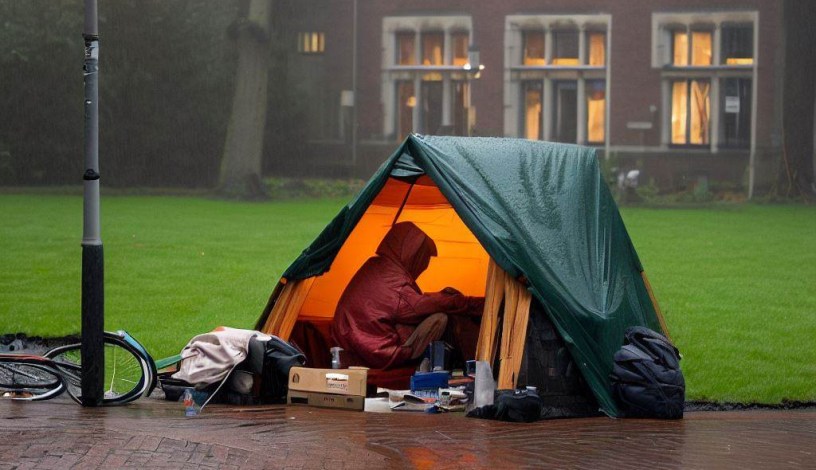
Every year, many hundreds of Wageningen students fall victim to rental fraud. Who are these scammers? What are the police, housing group administrators, Facebook and the university doing about it?
By: Marc van der Woude
For six months, I researched this issue and, as a journalist, talked to numerous aggrieved students as well as the parties who could do something about it from their role or position. I report my findings in this article, in the form of questions and answers.
Who are the scammers?
These are usually young men from West African scammer countries such as Ghana and Nigeria, sometimes Bangladesh, who operate from public internet cafes, making them difficult to trace. Like the scammers in my previous article, they are often highly educated but with no job prospects. Cybercrime is then an easy alternative to make money.
Locally, they are called ‘Yahoo Boys’, referring to the Yahoo e-mail addresses used for phishing. The criminals are decentralised and actively share information about victims (so-called ‘sucker lists’), tricks and bank accounts. They enjoy a star status in their own locality and like to flaunt their opulence on the socials. One month’s rent, extorted from a Wageningen student, is a whole month’s salary at home. If you have dozens of victims a month, you can live extremely well.
How do they proceed?
In my previous article, I described this through some actual cases. The scammers use fake profiles with made-up names, photos of other people randomly plucked from the internet (or nowadays generated with AI), photos and details of existing student rooms and private addresses. They use their victims’ stolen IDs to create new victims. Bank accounts are in banks with few controls, mostly in the Baltic States or the UK.
Is there any point in reporting it to the police?
In practice, no. The cases often involve relatively small amounts (a month’s rent with deposit) of between €500 and €1,500. To make a report, you will spend as little as two hours at the police station. Because the fraudsters are abroad and difficult to trace, detection is not a priority for the police. Sometimes a scam network is broken up, usually in an international context, but it is like putting a sticking plaster on a wooden leg.
Have you spoken to the police?
Yes. As part of my research, I spoke to several departments of the police. On this tour, it strikes me that there is little knowledge in the organisation. Police spokesperson Henk Kremer, for example, doesn’t know what a ‘housing scam’ is. “Never heard of it. I’ll have to inquire about that,” he replies.
Later I am called back by a senior spokesperson, Ruud Visser, to whom I put three questions:
1) How many reports of housing scams do you receive per year in Wageningen? And how many in the whole of the Netherlands?
2) Has that increased, decreased or remained the same recently? Do you see any seasonal peaks?
3) Is this being actively investigated by the police? What priority does this have in practice? If so, how are the police tackling this issue?
He is unable or unwilling to answer any of the questions. He is also not interested in any information that might contribute to a better understanding of this type of crime or to solving an ongoing case. He indicates that the volume of housing fraud is “very low”, in fact so low that the police do not have to do anything about it.
My impression: the police do not have a clear picture of the problem because (too) few people report it and no capacity is put on detection. “The system we use does not lend itself to such analysis,” Visser says. “There are many different ways in which criminals work, often with money mules who move the transferred money away quickly. That makes it extra challenging.” He says the solution lies not in detection, but in preventing the scams.
One duped person who emailed me her report to the Wageningen police informed me several months later that she had not heard anything about it. Another aggrieved person informs me that the police did not even want to take up the report, arguing that it was a ‘civil matter’, while fraud is really a criminal offence.
I also speak to neighbourhood police officer Wiro Pillen, responsible for the Haarweg student district in Wageningen. “Sometimes I feel ashamed of my colleagues,” he says. He is referring to the lack of pro-activity. “The criminal investigation department evaluates reports based on leads for detection and determines what actions can be taken. If a crook is in Africa, they do nothing with it. But giving feedback is the least they can do,” he says. He believes WUR itself should play an active role in prevention by better educating prospective students.
Does Wageningen University see a role for itself here?
“No,” says Ingrid Hijman, head of Wageningen University’s Student Service Centre. “We do not give advice to students, nor do we address problems of individual prospective students regarding housing. We refer to the relevant authorities.” Students who knocked on the SSC’s door after being defrauded let me know they were not heard by the university.
Spokesperson Vincent Koperdraat also confirmed that the university does not interfere with housing. As I described in a previous article, WUR’s basic attitude is: ‘We are here for education, not housing.’ The fact that this attitude, which also plays out in other university cities, puts students at a disadvantage does not seem to interest the university much.
But the university provides education on its website, right?
It does so very briefly and without the attention needed to educate effectively. The WUR’s housing page has a list of providers, and that’s it. Platforms the university refers to, such as Kamernet, KamerSocial, Huurwoningen, Rentsy and Huurstunt have problematic aspects. To contact landlords, room seekers have to take out a paid subscription. They then often have difficulty getting rid of this. By no means all offers really exist, sometimes rooms are displayed and held that are not actually available.
A website like RentSlam operates in the Randstad and has no offer in Wageningen. The university also promotes an asset investor like Sons Real Estate, an agency that actually ruins the market by driving up prices. The same goes for Short Stay Wageningen, which operates in the expensive tourist segment and is not a student housing provider.
Of the Facebook groups being promoted, Wageningen Student Plaza is the main one where students are being scammed. When I bring this to the university’s attention and offer to make a reliable shortlist, accompanied by useful hints and prevention tips, the information officers let me know that they are perfectly capable of doing that themselves. But months later, nothing has changed on their housing page.
So doesn’t the Housing Desk Wageningen play a role in this?
The Housing Desk is a foundation to which the university refers and where individuals can place room ads. Things regularly go wrong here too. The assessment criteria for offers are applied very arbitrarily by the Housing Desk, which regularly results in offers appearing that are either overpriced (rents between €1,000 and €2,000 per month) or fraudulent. Several times, the Housing Desk lacks discernment, duping students in the process. When I offer the Housing Desk to have a chat about scams and how to prevent them, they are not interested.
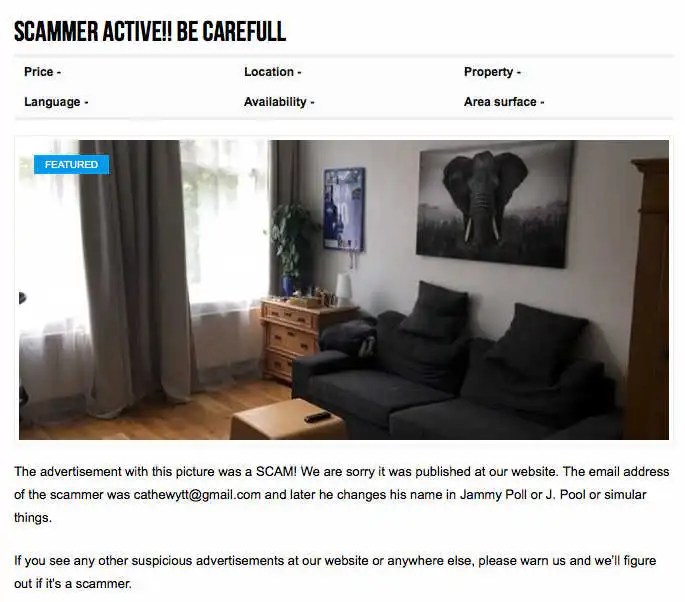
A post on the Housing Desk after yet another student has been duped.
Is there also a hotline for rental fraud?
Yes, there is the Fraud Helpdesk. When I ask press officer Tanya Wijngaarde if she knows which platforms are trustworthy or unreliable, she won’t answer. “We don’t offer a seal of approval,” she says. She does, however, reveal that the situation on rental agency websites has improved somewhat in recent years, thanks to a consultation with the public prosecutor’s office. “A number of platforms have taken measures, such as better monitoring of user profiles. But scams on social media, on the other hand, are increasing sharply. There is less control on that.” She confirms that the problem is much bigger than the police recognise. “Less than five per cent of the victims report it,” she says.
Why is it that scams are particularly prevalent on Facebook?
The main factor in this is the lack of moderation in many housing groups. In fact, some groups no longer have moderators at all. These were started by someone in the past, that person got other interests and did not appoint a successor, leaving the group orphaned. Precisely these kinds of groups are a magnet for scammers, because they can go about their business unchecked.
Even if there is a moderator, it is important that this person is proactive and knows very well what to look out for. Scammers should be caught right at the door. Once scammers are in your group, it is very difficult to detect and eliminate them. Scammers do not always place ads themselves, but approach room-seekers directly on Messenger with their offer, out of the moderator’s sight. If you want to keep a group guaranteed scam-free, you actually have to start from scratch again and build in strict controls at the front door. This can be done by setting entry questions and checking all profiles carefully.
In which housing groups are most scammers?
Most victims in my research have been scammed in these groups: Wageningen Student Plaza, Wageningen Student Housing (not to be confused with this website) and Room Rent Wageningen.
Are there any housing groups that are indeed safe?
Yes, there is one with the reputation of being spam and scam-free, which is very consistently moderated: Wageningen Room Sublets.
Do group moderators see the problem?
As part of my research, I also speak to some group moderators and ask them if they are aware of people being ripped off in their groups, and if they are open to tips on how to prevent this. The response to this is defensive. The problem is simply denied, or – as one moderator puts it, “That’s everyone’s own responsibility.” The problem, of course, is that not every student is equally discerning, and then it is up to the moderator to create a safe environment.
Can Facebook do anything about it?
Of course, I also contacted Facebook. The platform offers limited opportunities to ‘flag’ people. On trial, I report several scammers to Facebook and each time the system returns that the ad or scammers’ profile in question does not violate its guidelines. You can’t complain about that. You are dealing with an algorithm and employees who judge a report very quickly, without analysing it properly.
Getting to speak to a real human being at Facebook is not so easy. Still, I try. It takes some investigative journalistic cleverness to do so, but I eventually manage to arrange a video call with the team at Meta in Menlo Park responsible for the further development of the groups. In this meeting, several questions pass and intentions are expressed to give administrators better tools to moderate groups and keep them safer. As yet, none of these improvements have been implemented. They may still be on an action list at Meta, but just as well they end up in the waste basket. After all, it is a big company and I am just a simple journalist from the Netherlands.
What is my conclusion?
Back to my research question: what are the police, housing group administrators, Facebook and the university doing about it? In practice, little to nothing at all. Nobody feels responsible to do anything about the scam problem.
That leaves prevention: how can you avoid falling prey to a housing scam? In a forthcoming article, I will cover the best tips on how to detect a scammer. And I’ll debunk advice that won’t help you at all.
This publication was made possible in part by the Freelance Journalists Support Fund. It has been widely distributed in the housing groups on Facebook and will also appear in the local-regional press in mid-August 2023.
Emerge Media conducts investigative journalism independently and for media partners in the Food Valley. Got a tip? Send an email to info@emergemedia.nl and we’ll get back to you.
Don’t want to miss any new articles on student housing in Wageningen? Sign up and you’ll be the first one to receive them in your mailbox.
Together we can improve student housing in Wageningen. You can support our work with a small tip or donation.
 Wageningen Student Housing